

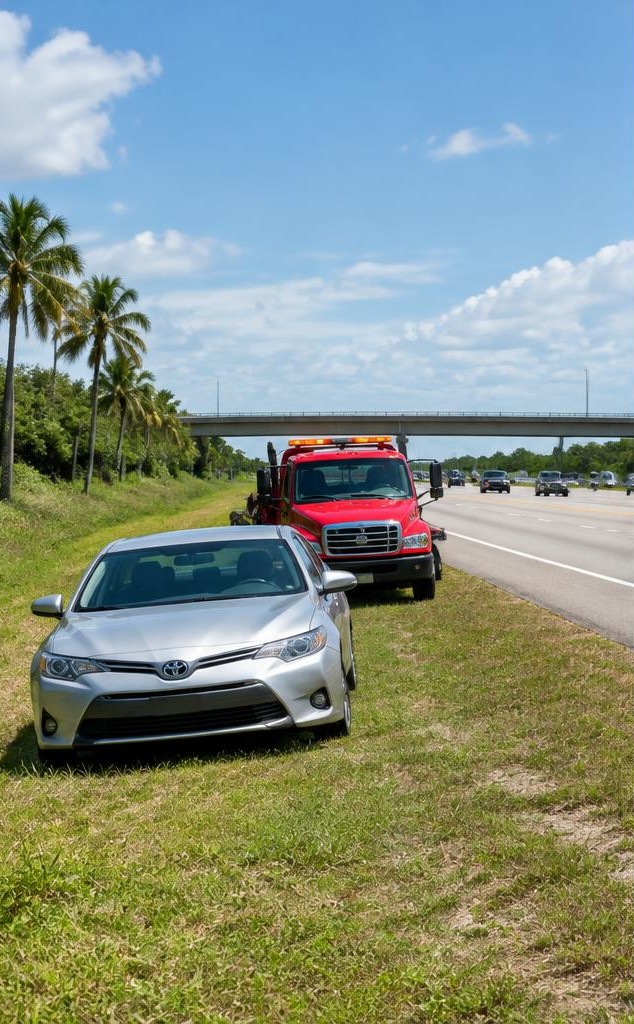
A breakdown on I-4 or SR-429 is not just a vehicle problem. Traffic continues moving while you decide what to do, and a shoulder can feel much less protected than a parking lot. Your first task is to reduce exposure to traffic, not to diagnose the engine. If someone is hurt or there is an immediate danger, contact emergency services. Follow the directions of law enforcement and roadway personnel rather than treating a tow request as a substitute for emergency help.
Get out of the travel lane if you safely can
If the vehicle can still move safely, look for a place away from moving traffic. Avoid sudden braking or a sharp turn across lanes. A safe exit or permitted parking area may be a better waiting location than a narrow shoulder, but do not keep driving a car that cannot be controlled or is showing signs of serious mechanical trouble. Once stopped, use the vehicle’s warning lights when appropriate and take a moment to understand your surroundings.
If you cannot move the vehicle out of a travel lane, make that clear when contacting emergency services. The urgency is different from a car already sitting in a lot. Do not walk into traffic to place objects around the car or to inspect a tire. A breakdown can turn into a collision if the driver focuses on the vehicle and forgets the vehicles passing nearby. Keep people’s safety ahead of property and repairs.
Decide where to wait based on the actual danger
There is no single instruction that fits every roadside position. A car safely beyond the traffic lanes presents a different situation from a vehicle stopped where it could be struck. Avoid opening a door into traffic or standing between vehicles. If you must leave because of immediate danger, choose the side away from moving vehicles when possible and follow emergency directions. Do not move to a location that introduces another hazard, such as unstable ground or a steep ditch.
Keep children and other passengers together. A person trying to help can accidentally step into a dangerous area while watching the disabled car. If someone is outside the vehicle, do not let them stand in front of or behind it where an approaching vehicle could push it toward them. Weather adds another consideration: heavy rain reduces visibility and makes a paved shoulder feel less secure. Your waiting position should account for both traffic and the conditions around you.
Report a location that someone can actually find
An interstate name alone is not a pickup location. Share your direction of travel, the nearest exit or recognizable landmark, and whether you are before or after it. If your phone can provide a location pin, confirm that it represents the current position of the vehicle, not the place where it first began losing power. Say whether you are on a shoulder, an exit ramp, a frontage road or already inside a business lot.
Once you safely leave the highway, update anyone coordinating the pickup. A truck heading toward an old location cannot infer where you moved. In the Orlando area, nearby roads may run parallel without connecting directly, so describing the entrance also helps. If you are in a hotel or shopping lot, tell the crew which part of the property contains the car and whether collection permission is needed.
Understand the role of highway authorities
On some highway stretches, law enforcement assigns the towing company clearing an incident. If an officer or roadway responder gives instructions, follow them. Calling a different company does not override that process. Once the vehicle is safely off the highway or released from the scene, you can discuss later transport to a mechanic, dealer or other approved destination. Clearing a highway incident and arranging a later vehicle move are separate situations.
Florida’s Move Over law is meant to protect people and stopped vehicles along the roadway. Other drivers have responsibilities around qualifying stopped vehicles, but the law is not a protective barrier around your car. Never assume everyone approaching will see you, slow down or move away. For exact legal requirements, consult Florida’s official highway-safety guidance. While waiting, focus on a safe position rather than relying on another driver to react correctly.
Prepare the vehicle details without taking risks
A useful tow conversation includes the make and model, whether the engine starts, whether the wheels roll, whether keys are available and any damage. You do not need to step into traffic to obtain those facts. Tell the crew what you know and what you cannot safely check. A locked wheel, flat tire or damaged suspension may change loading. An AWD or low-clearance vehicle also deserves its own description instead of being treated as just another car.
For car and SUV towing, provide your current pickup and preferred destination. If the vehicle has been involved in a collision, describe that carefully when discussing accident towing. Check with the receiving shop before asking for delivery. Its opening hours, parking instructions and ability to accept the car matter. You can find local pickup guidance on our Orlando service-area page.
Keep the handoff clear
Keep your phone reachable and conserve its battery. Have a receiving contact ready and tell the crew who will meet the vehicle. Remove essential personal belongings only when it is safe. Do not attempt an improvised repair beside passing traffic just to avoid a tow. A calm description of the location and condition is more useful than putting yourself at risk for one extra detail.
Central FL Auto Towing & Recovery is based in Apopka and has served Central Florida since 2016. Our service reach is up to 100 miles from Apopka. Call to discuss the vehicle and confirm the pickup; an online request is not a confirmed booking. If you are still in a dangerous highway position, emergency and roadway instructions come first.
A local crew. One call.
Tell us about the vehicle and your destination.
(888) 563-1435Open 24 hours, 7 days
REQUEST A TOW